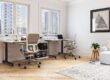
We design workspaces and install furniture for a living. But the reason we show up has never really been the furniture.
What does that mean for Freeform, our team, and our customers?
As the second generation in a family business, I’m committed to ensuring that the way we conduct business maximizes the positive impact we have on our community’s internal and external stakeholders. I see this aim as not only the right thing to do, but as an obligation I must fulfill to ensure my company’s actions add value to our community and partners, rather than only extracting from them.
When I talk about this, people often assume I mean some sort of environmental audit: a box you tick once a year and then put a sticker on the door. That’s a portion of it. But the way I think about good business is a lot more holistic, and it shows up in five places: how we govern ourselves, how we treat our team, how we show up in our community, the footprint we leave on the environment, and what we deliver to our customers.
None of those are side projects. They’re the job.
The most sustainable piece of furniture is almost always the one you already own. A good part of our job is helping people see that before they sign a purchase order.
Sustainability is a practice, not a promise
In our industry it is very easy to talk about sustainability, and very easy to sell against it. The honest version, for us, is less glamorous than a marketing campaign: we try to keep furniture working, and in use, for as long as it possibly can be.
In practice, that looks like:
- Specifying for the long haul. Commercial-grade furniture costs more up front because it’s built to survive a decade or more of daily use. Cheap furniture isn’t cheap; it’s just a purchase you make several times.
- Reconfiguring before replacing. Before we quote new product, we look hard at what a client already has. We once reconfigured an entire group of workstations in our own office for about $500, and we would far rather do that for a customer than sell them a floor of new desks they didn’t need.
- Moves, adds, and changes. When a team grows or relocates, the furniture should go with them. Our reconfiguration and relocation services exist so that a change in headcount doesn’t quietly become a dumpster.
- Repair over landfill. Our warranty and service team exists to fix things. A failed cylinder or a torn panel is a repair, not a reason to throw a chair away.
- Designing for change. Specifying modular, adaptable product means a space can evolve over time instead of being ripped out and started over.
None of that is complicated. It’s just less profitable than selling everything twice, which is precisely why I think it’s worth saying out loud.
We don’t think we’ve got this finished, either. Continuous improvement (Kaizen) is one of our core values, and it applies to how we run this company just as much as it applies to how we run a project.
We care about the places we work
We’ve been doing this in the Inland Northwest for more than three decades, and it matters to us that we aren’t visitors here. Our team lives in these communities. Our kids go to school here. The workplaces, classrooms, clinics, and banks we furnish are used by our neighbors every single day.
That proximity is a useful kind of accountability. It’s a lot harder to cut a corner on a project when you know you’ll run into the client at the grocery store on Saturday.
Giving back, in a multitude of ways
In 2021 we formed a charitable committee, and we deliberately built it out of employees from outside the leadership team of the company. I didn’t want our giving to end up being a reflection of whatever the CEO happens to care about. The committee decides where our support goes.
Their work includes:
- Volunteer opportunities with local organizations and non-profits
- Monetary donations to local non-profits, and to fundraising efforts that align with our core values
- Community partnerships and sponsorship
- Events, both internal and external, that raise money for local charities
The largest of those is an annual bocce ball tournament for the construction and design industry. It raises real money for local charities, and it does something else I honestly didn’t anticipate: it gets a competitive industry onto the same lawn, on the same afternoon, doing something generous together.
A few questions worth sitting with
Whether or not you’re in our industry, these are the questions I keep coming back to:
- How can we make it more enjoyable for employees to show up at work every day?
- How can we ensure that businesses support their community and not just bleed it dry?
- How can we drive less waste, not just in material waste, but in people’s time and emotional energy?
- And if you don’t own a business, how can you challenge ownership to view the role of their business within the community and the world in a different light?
By existing and operating the way we do, our aim is to put more back into the community and the people that work for and with us than we pull out of it. Essentially, our goal is to be a net positive to our community, people, and environment. That aim is the same thing our core purpose has said all along: to create culture, build community, and enrich lives.
Thanks for taking time to see what we’ve been up to, and please do try to bring a little more GOOD into the world!
 Yours,