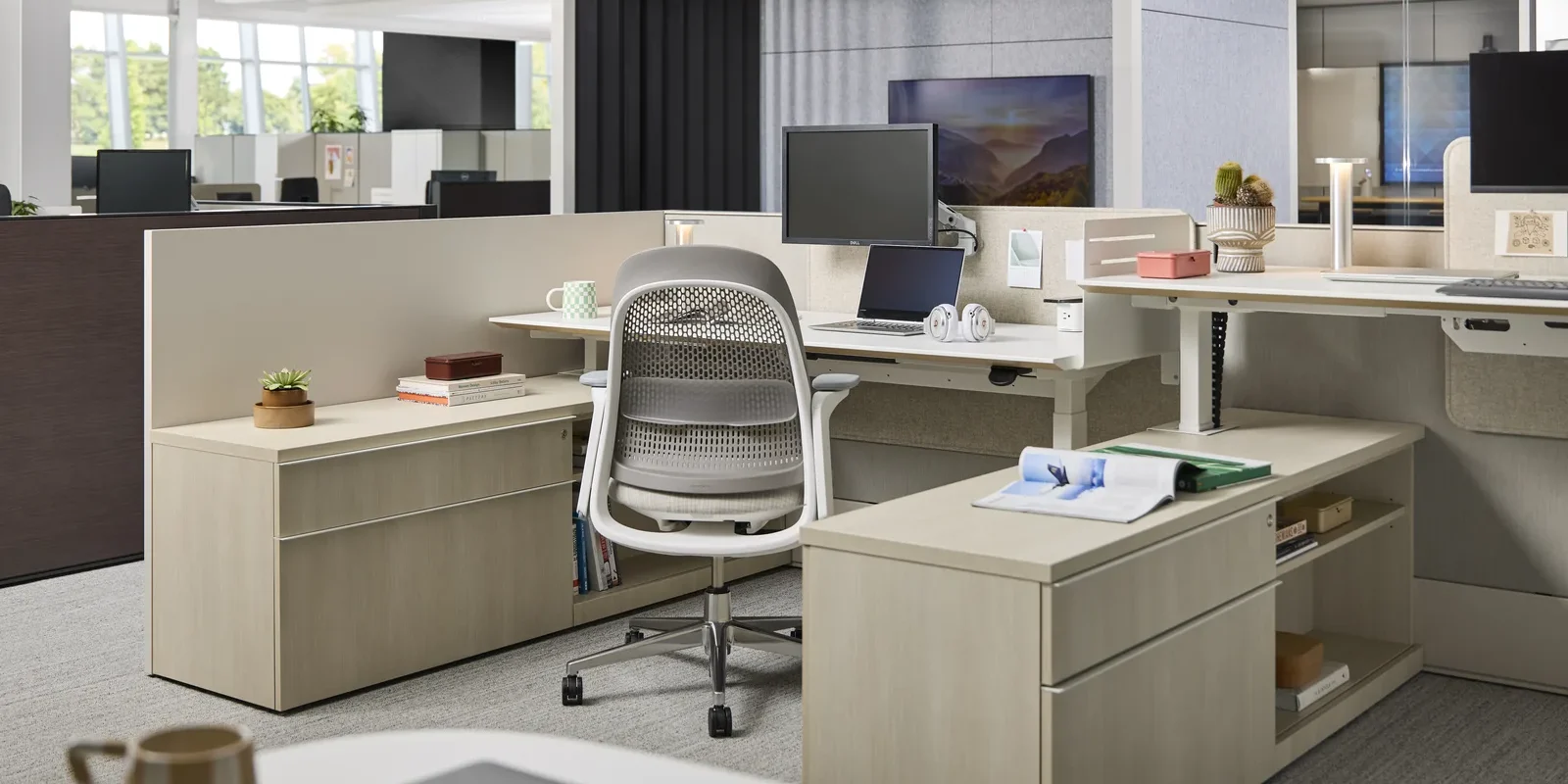
Selecting the right business furniture is one of the most consequential decisions a company can make for its physical environment. The wrong choices create discomfort, reduce output, and communicate the wrong message to both employees and clients.
Getting it right, on the other hand, reinforces culture, supports health, and positions a workplace to perform at a higher level.
Start With How the Space Will Be Used
Before any purchasing decisions are made, a clear picture of daily workflows is necessary. The type of work performed, the size of teams, and the frequency of client visits all shape what furniture categories belong in a space.
A legal firm that hosts confidential client meetings has entirely different requirements than a marketing agency running daily stand-ups and collaborative sprints. Identifying these patterns early prevents costly mismatches between furniture and function.
It helps to audit the space and categorize it by activity zone. Common zones to plan around include:
- Focused individual work areas that require a quiet, personal workspace
- Collaborative zones for group problem-solving, ideation, and spontaneous conversation
- Reception and client-facing areas, anchored by reception desks, that shape first impressions
- Breakout spaces with lounge furniture that supports informal interaction and mental recovery
Know the Core Office Furniture Categories
Commercial office furniture falls into a handful of categories, and a complete plan usually draws from all of them.
- Desks: Office desks range from compact computer desks to an executive desk with built-in storage; an l-shaped office desk, often sold as a reversible l-shaped unit, multiplies surface area in the same footprint, and electric height adjustable models are now the standard ergonomic desk specification.
- Chairs: Task chairs with breathable mesh backs, desk chairs for rotating teams, and guest chairs for visitors each do a different job.
- Tables: Conference tables for the conference room, training room tables that fold and nest, a shared work table for project spreads, and a side table or two in the lounge.
- Storage: A lateral file cabinet, a storage cabinet with flexible shelving, a desk with storage in a mobile file drawer underneath, or a hutch where vertical space is tight.
Every accessory earns its place too; monitor arms, keyboard trays, and power access complete the setup.
Prioritize Ergonomics From the Beginning
An ergonomic office starts with the chair, and ergonomics is not a premium upgrade. According to research published by the Occupational Safety and Health Administration, musculoskeletal disorders related to poor workstation design account for a significant share of on-the-job injuries and lost productivity.
Choosing furniture that supports human biomechanics from day one reduces absenteeism and long-term healthcare costs.
Quality ergonomic seating offers lumbar support that moves with you, movable armrests, and customizable seat depth to accommodate a range of body types. These are not optional features for an office chair someone sits in for six or more hours per day.
Sit-stand desks have become a standard specification in well-designed offices. Alternating between sitting and standing positions throughout the day improves circulation, reduces spinal strain, and keeps energy levels more consistent.
Pair a sit-stand surface with monitor arms and keyboard trays to complete a properly configured setup.
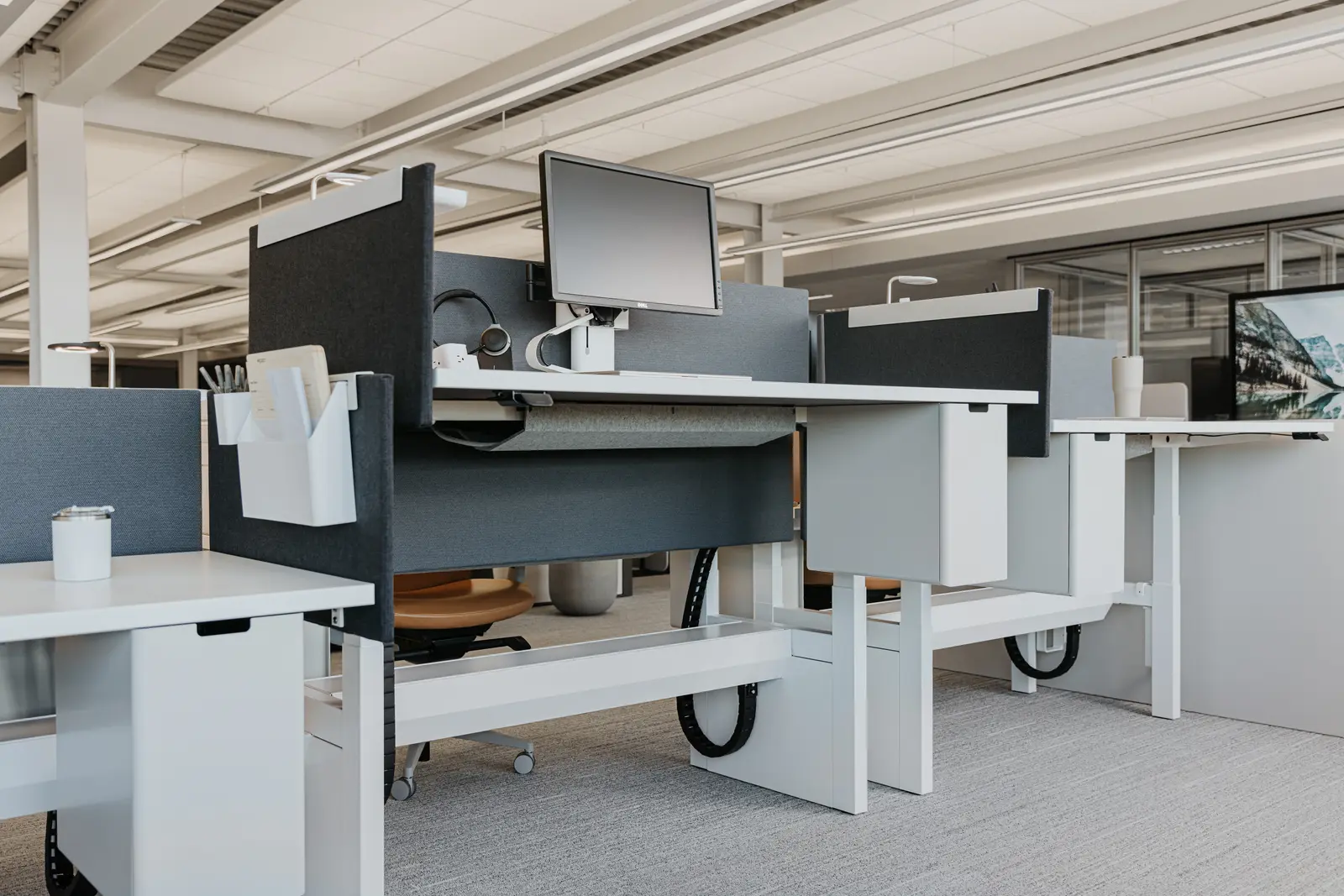
Match the Furniture Scale to Your Office
Overscaled furniture in a compact office space creates congestion and makes a space feel oppressive. Undersized furniture in a large, open floor plan can feel sparse and disconnected.
Scale is a factor that buyers sometimes overlook when shopping from a catalog or online without seeing pieces in person.
A general rule is to leave at least 36 inches of clear circulation path between primary furniture pieces, per standard Americans with Disabilities Act guidelines from the U.S. Access Board. This keeps the space navigable and comfortable for all employees.
Measure the footprint of each piece before ordering, and use a scaled floor plan to test arrangements. Many furniture dealers and showrooms offer planning services that help avoid expensive mistakes before delivery day.
Think About Flexibility and Reconfiguration
Organizations rarely stay static. Teams grow, reporting structures shift, and hybrid work models have teams splitting the week between the workplace and home offices.
Furniture that can be reconfigured without requiring professional installation gives a business the ability to adapt without a full replacement cycle.
Modular systems are particularly valuable here. Cubicle and panel systems with connectable components, mobile carts with locking casters, and freestanding storage units allow a facility manager to respond to change quickly. Furniture that serves multiple configurations over a three-to-five-year period delivers a significantly better return than fixed, single-purpose pieces.
Consider Material Quality and Durability
Commercial pieces operate under heavier daily use than residential furniture. A task chair used eight hours per day, five days per week, accumulates roughly 2,000 hours of use per year.
Materials and construction quality need to reflect that level of demand.
Key material considerations when evaluating options include:
- Frame construction: Steel and high-grade aluminum frames outperform thin particleboard or hollow plastics in commercial environments
- Upholstery grade: Contract-grade fabrics are rated for 100,000 double-rubs or more, versus 15,000 to 30,000 for standard residential fabrics
- Surface materials: High-pressure laminate and solid hardwood surfaces resist scratching and moisture better than lower-cost alternatives
- Warranty terms: Reputable commercial furniture manufacturers typically offer five-to-twelve-year warranties on structural components
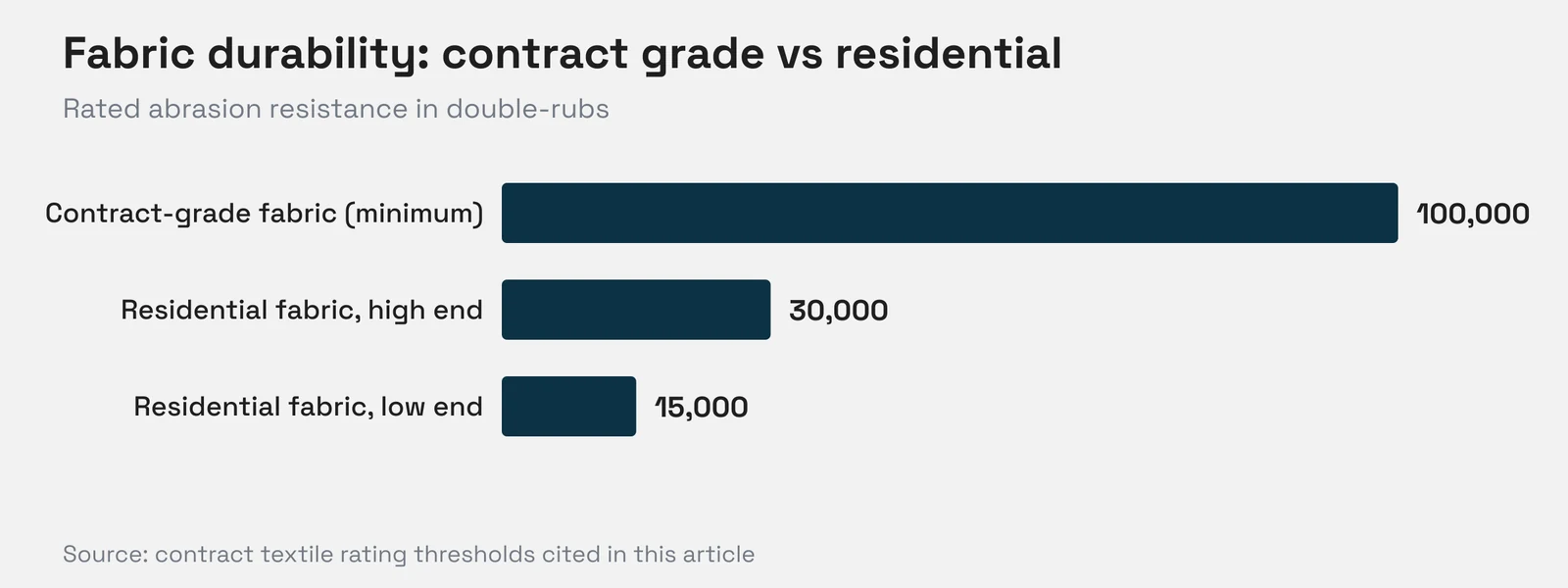
Investing in durable materials upfront usually costs less over a five-year horizon than replacing lower-quality pieces every two to three years.
| Component | What to look for | Benchmark |
|---|---|---|
| Frame construction | Steel or high-grade aluminum | Outperforms particleboard and hollow plastic |
| Upholstery | Contract-grade fabric | 100,000 double-rubs or more |
| Work surfaces | High-pressure laminate or solid hardwood | Resists scratching and moisture |
| Structural warranty | Coverage from a reputable manufacturer | Five to twelve years |
The Haworth Office Lines We Put to Work
Freeform is a Haworth dealer, so the benchmarks above are not theoretical. They map to lines we specify, deliver, and install every month.
Breck: The Everyday Workhorse
In an independent comparative study of four office chairs, Breck earned the highest overall comfort rating across 22 participants, and 100% of them rated its seat depth as “just right.”
The GeoStretch back flexes across three zones, a weight-activated mechanism balances support automatically, and it assembles from four parts in under a minute. Haworth backs it with a 12-year parts and labor warranty.
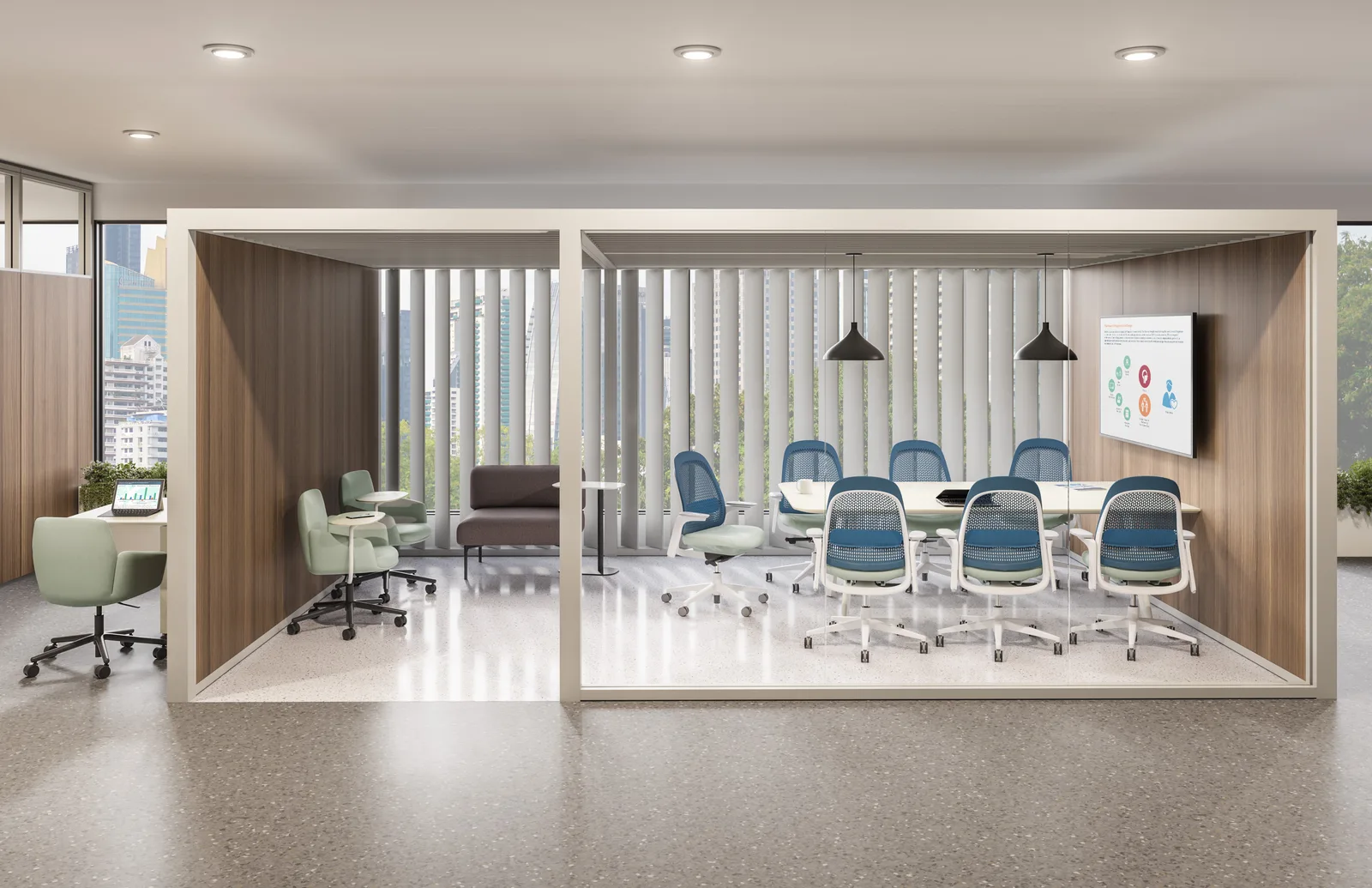
The Sit-Stand Setup That Gets Used: Upside and Zody LX
The Upside benching pictured above lets each person set their own working height without breaking the shared footprint of the bench.
Pair it with Zody LX, whose dual-posture option supports the in-between perch of sit-to-stand work. It carries 4D arms, a 400-pound rating, and the same 12-year, around-the-clock warranty.
Breakout and Client-Facing: Moxie
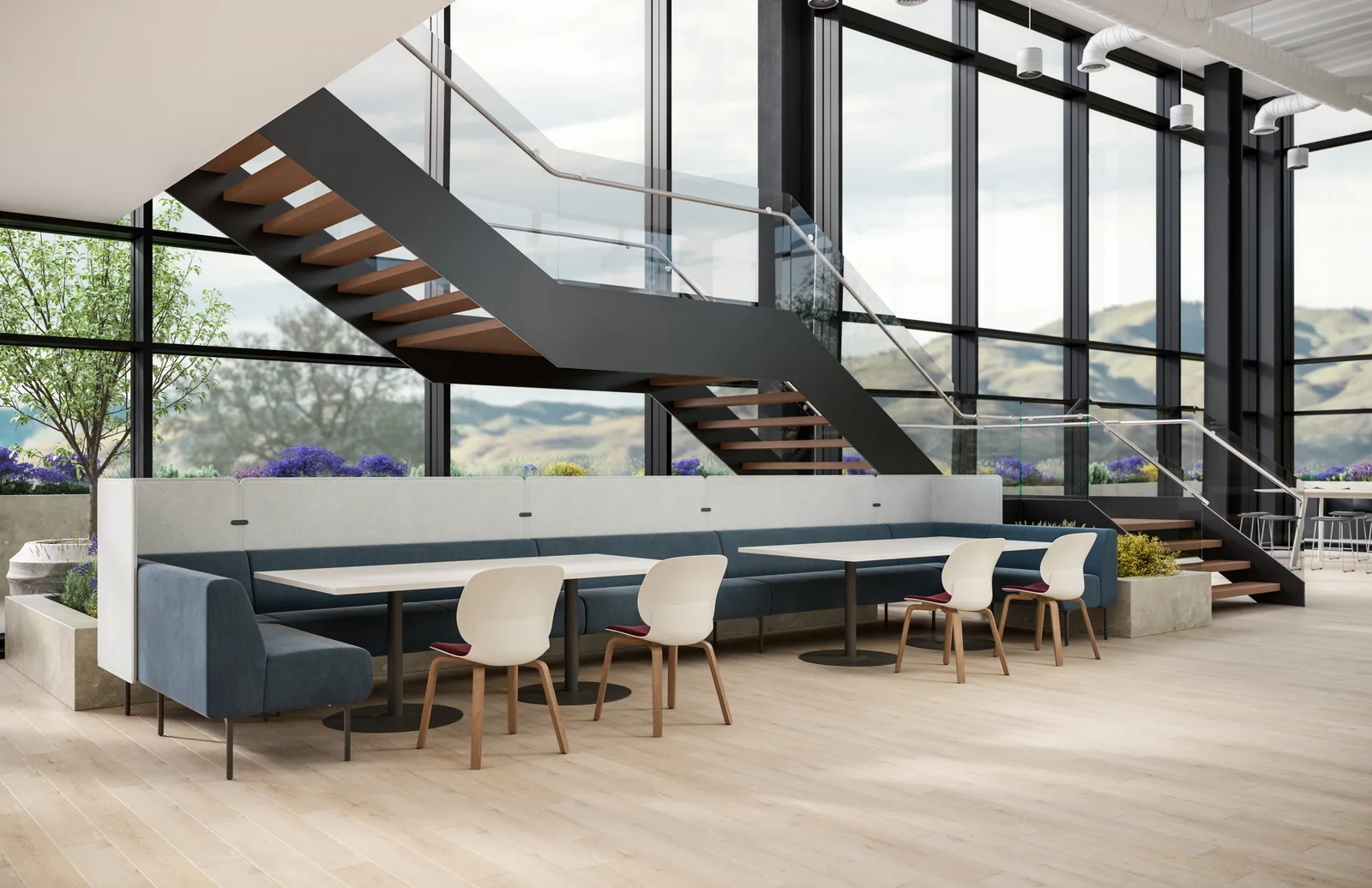
Moxie modular lounge builds in 6-inch width increments, so a breakout corner and a client-facing lounge can share one product family.
Each seated position is rated to 600 pounds, cleanable surfaces are an option, and power arrives built in with a discrete cable channel.
Align Aesthetics With Brand and Culture
The physical environment communicates organizational values before a single conversation takes place. Clients, candidates, and visitors form an impression of a business within seconds of entering the space.
Furniture plays a central role in that perception.
A technology company that values innovation and openness may gravitate toward sleek modern designs, mixed materials, and flexible lounge configurations. A financial services firm projecting stability and trust may prefer more traditional wood tones, structured armchairs, and formal conference setups.
Neither direction is universally correct. The right aesthetic is the one that honestly reflects the organization it represents.
Color also carries meaning. Neutral palettes create calm, focused environments, while bolder accent colors in collaborative zones can signal energy and creativity.
Finishes matter too: wood tones from espresso to light oak help coordinate zones and craft one cohesive look. Working with a furniture specialist who understands spatial design helps translate brand identity into stylish and functional choices.
Set a Realistic Budget and Total Cost of Ownership
Budget constraints are a reality for every purchasing decision, but evaluating furniture on purchase price alone leads to poor long-term outcomes. Premium office furniture usually justifies the gap over its useful life.
Total cost of ownership accounts for durability, warranty coverage, maintenance requirements, and the productivity impact of the furniture over its useful life.
A mid-range ergonomic task chair priced at $600 to $900 may seem expensive compared to a basic model at $150, but if the less expensive option requires replacement in 18 months or contributes to employee discomfort and sick days, the arithmetic quickly favors quality furniture. The pre-owned market can stretch a budget as well; used office furniture from a dealer’s warehouse or outlet program arrives inspected and warrantied.
Plan the budget around zones of priority, typically allocating more per seat for primary workstations and less for occasional-use areas.
Visit a Showroom and Work With a Local Specialist
Purchasing through a local specialist rather than a generic online retailer offers several practical advantages. Specialists can conduct space assessments, assist with phased purchasing, and provide delivery and installation services that guarantee pieces arrive correctly and are set up properly.
For organizations in the Pacific Northwest, exploring office furniture in Spokane through a dedicated office furniture showroom gives buyers the ability to experience pieces in person before committing. Similarly, companies in the Tri-Cities region can evaluate options for office furniture in Richland at a showroom staffed by professionals who understand commercial specifications and space planning.
Local expertise also means faster lead times on popular product lines and easier resolution when post-delivery adjustments are needed. The transaction is the start of the relationship, not the end of it.
Frequently Asked Questions
How long does quality commercial furniture typically last?
Well-constructed commercial furniture from reputable manufacturers typically lasts seven to fifteen years under normal use. Warranty terms are a useful proxy for expected lifespan.
Products with ten-year or longer structural warranties are generally built to remain in service for at least that period.
Is ergonomic furniture worth the additional cost for small businesses?
Yes, ergonomic furniture pays back its cost through reduced absenteeism, fewer workers’ compensation claims, and measurable productivity gains. Even a small team of five employees spending less time managing discomfort or back pain will recover the cost difference within one to two years in most cases.
Should furniture match across all zones?
Full uniformity is not required, but visual cohesion across zones creates a more professional appearance. Most designers recommend establishing a consistent material palette and color family, then varying the furniture typologies by zone.
This approach allows collaborative areas to feel different from focused workstations while keeping the overall space feeling intentional and organized.
Ready to Furnish Your Business Space?
The team at Freeform works with organizations across the Pacific Northwest to specify, source, and install furniture solutions that match the specific needs and visual goals of each project. Contact us today to start a conversation about your space.
Keep reading
- Medical Office Furniture: Why Your Healthcare Practice Needs a Refresh
- The Architect of Atmosphere: A Guide to Choosing the Best Restaurant Furniture
- Prioritizing Commercial-Grade Durability: Choosing High-Quality Hospitality Furniture
- How To Choose Commercial Outdoor Furniture: A Guide
- How Does Commercial Furniture Benefit Higher Education Spaces?